
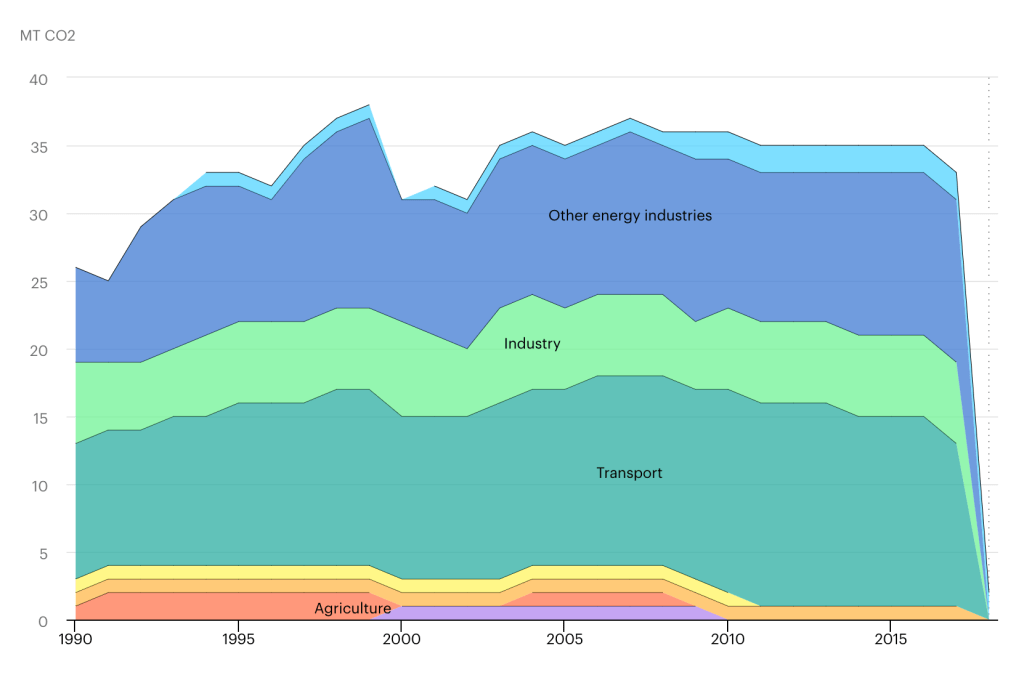
As stated in the website of the Norwegian climate and environment department; Norway’s government is committed to reduce by 40% its greenhouse gases (GHG) emissions by 2030–today being slightly below 35 million tons of CO2[1] (Fig.1)–and reach almost carbon-neutrality by 2050 [2]. This means that Norway will have to reduce 14 million tons of its CO2 emissions by 2030.
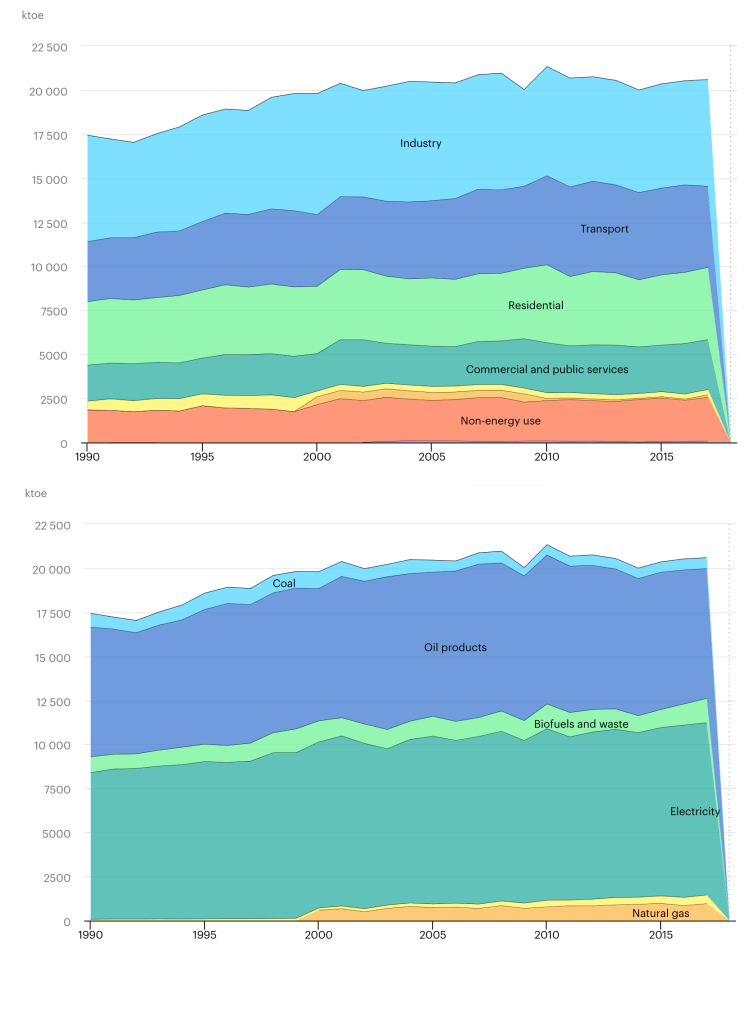
The Norwegian energy consumption profile by sectors and energy source looks like this (Fig. 2):
The question that arises, therefore, is how does Norway plan to achieve this ambitious–yet necessary–goal? The strategy, on paper, seems clear: to reduce the consumption of carbon-emitting combustibles. However, in today’s heavily energy-dependent economy and society, this is not so easily achievable.
Renewable energies, therefore, are set to play an important role for achieving the required reductions in GHG emissions.
Norway’s hydrological resources together with a small population makes it the top-one country in relative hydroelectricity consumption–that is; nearly all electricity consumed in Norway comes from clean-energy (hydropower) production.
In 2018, Norway produced 144,1TWh of electricity from hydropower and consumed 122,2TWh from its 244TWh total yearly energy consumption [3], [4]–fossil fuels providing the remaining energy share. The renewable energy growth, thus, must close the gap as well as cover the significant fraction of energy produced by non-renewable combustion (Figure 2) together with the expected growth in energy-need for the next decade.
This requires improvements on multiple fronts. From obvious green initiatives such as introduction of additional renewable energy, to light- green initiatives where we only reduce the GHG emissions by changing to less GHG emitting energy forms; such as from coal to gas.
Equinor, the Norwegian oil company (known before as Statoil), recently announced the discovery of a new oilfield (named Johan Sverdrup) 140km from the west-coast of Norway [5] and stated, at the same time, to be committed to meet the climate goals of Norway by claiming to exploit this new oilfield using renewable-generated electricity–in contrast to the previous gas-powered offshore platforms–thereby, reducing their emissions in oil-extraction.
It is not clear, though, i) how many of Equinor’s oil-platforms will be run by renewable-energy generated electricity, ii) if Norway has enough electricity capacity/potential to power all of its oil-exploitations with CO2-null emitting technologies and last iii) if the total net global balance of CO2 will actually be reduced.
Of these, the latter question is perhaps the most interesting and has been thoroughly investigated in the literature [6]. The general conclusion is that a significant net- positive effect heavily depends on the origin of the replacement power (electrical).
With this, we must distinguish the following scenarios: at the national level, emission reductions are greater due to the high fraction of renewable energy (hydroelectricity) in the norwegian electrical grid. However, the local offshore emission savings are shifted abroad as the electrification of local platforms will reduce the access of total hydroelectrical power in the common electrical grid (Europe, in this case). As such, the overall net- reduction is significantly less compared to the national reduction and is generally limited to the difference in the averaged CO2 emissions/kWh from the European energy mix (approximately 270g CO2/kWh [7]) and the emissions from the less efficient on-site offshore gas turbines. Additionally, one must account for the electrical losses associated with transmission when the electrical generation is off-site.
This is well represented in Figure 3 which describes the life-time CO2 emissions- both national and overall in the context of electrification of the Dagny and Draupnel/Luno project in Norway (taken as an illustrative example).

An additional point is the effect of increased gas export. If oil and gas companies now power themselves with renewable-generated electricity or from the electrical grid, they will, in theory, have a surplus of oil and gas to sell in the energy market; it can be speculated that the increased access to gas will reduce its price and thereby displace coal energy in the common European market. This principle, however, becomes less true as coal is phased out from the energy market and renewables phased in. Despite this, it should be noted that shifting the emissions associated with electrical power generation from an offshore gas turbine to an onshore high efficiently gas power station will contribute to a net-positive effect.
All in all, there are multiple factors influencing the global energy market and its derived CO2 emissions.
For the case of Norway meeting its future climate goals; they ought to obtain energy from other null-emitting technologies such as wind-power generation or an optimal combination of the strong and weak points of the different renewable-technologies (which we hope to explore in future posts).
The number of climatic and natural disasters is on the rise; the Australian fires caught the world eye not only for its magnitude in extension–greater than the Amazonas fires–but for the tremendous ecosystem loss; recently, an unusual strong storm hit the Catalan coast-line in Spain causing several material and natural damages. We are, therefore, faced with the challenge of designing better and more environment-respectful strategies and technologies which will require a global common effort.
GLS
References
[1] IEA, “International Energy Agency.”
[2] K. Miljødepartement, “Klimastrategi for 2030 – norsk omstilling i europeisk samarbeid,” vol. 41, 2017.
[3] Olje- og energidepartament, “Energi Fakta Norge.”
[4] SSB, “Statistisk sentralbyrå (Statistics Norway).”
[5] Equinor, “https://www.equinor.com/no/what-we-do/johan-sverdrup.html,” 2020.
[6] Econ Pöyry, CO2-emissions effect of electrification. 2011.
[7] European Environment Agency, “European Environment Agency,” 2020.


